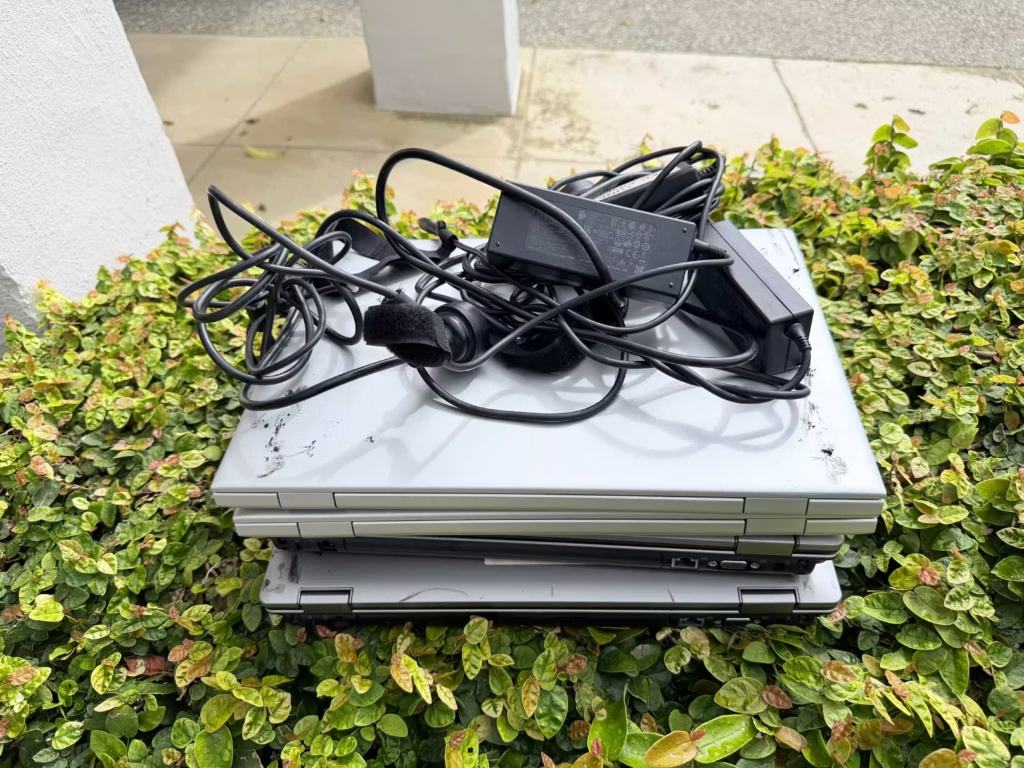
Cybersecurity threats are evolving fast—and one of the biggest risks to New Zealand businesses isn’t coming from hackers breaking in through the network. It’s coming from discarded corporate devices that were never securely wiped or disposed of.
A recent example, the Adobe Acrobat and Reader Vulnerability (CVE‑2026‑34621), highlights how dangerous retired or unpatched devices can be when they fall into the wrong hands. Even a single laptop or tablet left in storage—or thrown away without proper data destruction—can expose your entire organization to a serious breach.
Vulnerabilities like CVE-2026-34621 allow attackers to exploit “Prototype Pollution” to execute code. On a discarded or unpatched device, this enables:
- MFA Bypass: Cached browser tokens allow hackers to stay logged into Microsoft 365 or Google Workspace without a password.
- Network Pivoting: Saved VPN credentials provide a trusted path straight through your perimeter.
- Data Recovery: Without industrial-grade sanitization, PII (Personally Identifiable Information) remains recoverable, putting you in direct conflict with the NZ Privacy Act.
⚠️ A Recent Vulnerability That Exposes the Risk
The Adobe CVE‑2026‑34621 vulnerability allows attackers to manipulate internal application objects, leading to “Arbitrary Code Execution.”
Why does this matter for e-waste? If a discarded device still contains sensitive files, cached credentials, or even just old PDFs in a “Downloads” folder, an attacker who acquires that hardware can exploit this flaw to gain total control over the machine’s local environment. From there, they can pivot into your cloud networks using saved login tokens.
Official Advisory:Adobe Security Bulletin APSB26-43
This is exactly why secure e‑waste disposal is no longer just an environmental responsibility—it’s a fundamental cybersecurity requirement.
What’s Really Stored on “Wiped” Corporate Devices?
Many NZ businesses assume a factory reset is enough. However, without professional data sanitization, the following often remains recoverable:
- Customer Information: PII that triggers mandatory reporting under the NZ Privacy Act.
- Saved Passwords & VPN Credentials: A “golden key” to your office network.
- Browser Histories & Cloud Access Tokens: Allowing hackers to bypass 2FA and stay logged into your Microsoft 365 or Google Workspace.
- Intellectual Property: Proprietary designs, quotes, and strategy documents.
Compliance & Legal Risks for NZ Businesses
In 2026, New Zealand’s privacy landscape is stricter than ever. Failing to dispose of devices securely is no longer a “minor oversight”—it’s a legal liability. Under the Privacy Act, a breach caused by improper hardware disposal can lead to:
- Mandatory Breach Notifications: Publicly admitting your data was found in a landfill.
- Financial Penalties: For failing to take “reasonable steps” to protect information.
- Loss of Government/Corporate Contracts: Most modern RFPs now require proof of secure IT Asset Disposition (ITAD).
Regulatory Deadline: 1 May 2026
The legal landscape in New Zealand has shifted. The Privacy Amendment Act 2025 introduces Information Privacy Principle 3A (IPP 3A), effective 1 May 2026.
Under this new mandate, the Office of the Privacy Commissioner requires organisations to demonstrate “reasonable steps” in protecting data. Failing to provide a verifiable Chain of Custody for retired IT assets now carries:
- Mandatory Breach Notifications: The requirement to publicly admit if customer data is found in a landfill.
- Contractual Liability: Most modern NZ government and corporate RFPs now mandate proof of secure IT Asset Disposition (ITAD).
How We Protects Your Business –
ExTech eWaste Solutions provides a defensible audit trail for corporate electronics across New Zealand. We don’t just “recycle”—we destroy the risk.
- Certified Data Destruction: Both digital wiping (overwriting) and physical shredding of drives.
- Secure Chain-of-Custody: Documentation that proves exactly where your device went from the moment it left your office until it was destroyed.
- Certificate of Destruction (CoD): Your legal “get out of jail free card” for compliance audits.
- NZ Environmental Standards: Ensuring your old tech stays out of landfills while your data stays out of the wrong hands.
Cybersecurity Starts at Disposal, Not Just Deployment
Vulnerabilities like CVE‑2026‑34621 prove that outdated devices remain exploitable long after they’re retired. Don’t let your old hardware become your next data breach.
Security Starts at Disposal
With the National Cyber Security Centre (NCSC) reporting a surge in exploited vulnerabilities this month, “storage” is no longer a security strategy.
Ensure your business is compliant before the May 1 deadline. Protect your data. Protect your business. Protect the environment.
Book a Free Corporate e‑Waste Audit
ExTech helps New Zealand businesses dispose of IT assets securely, sustainably, and with full compliance.