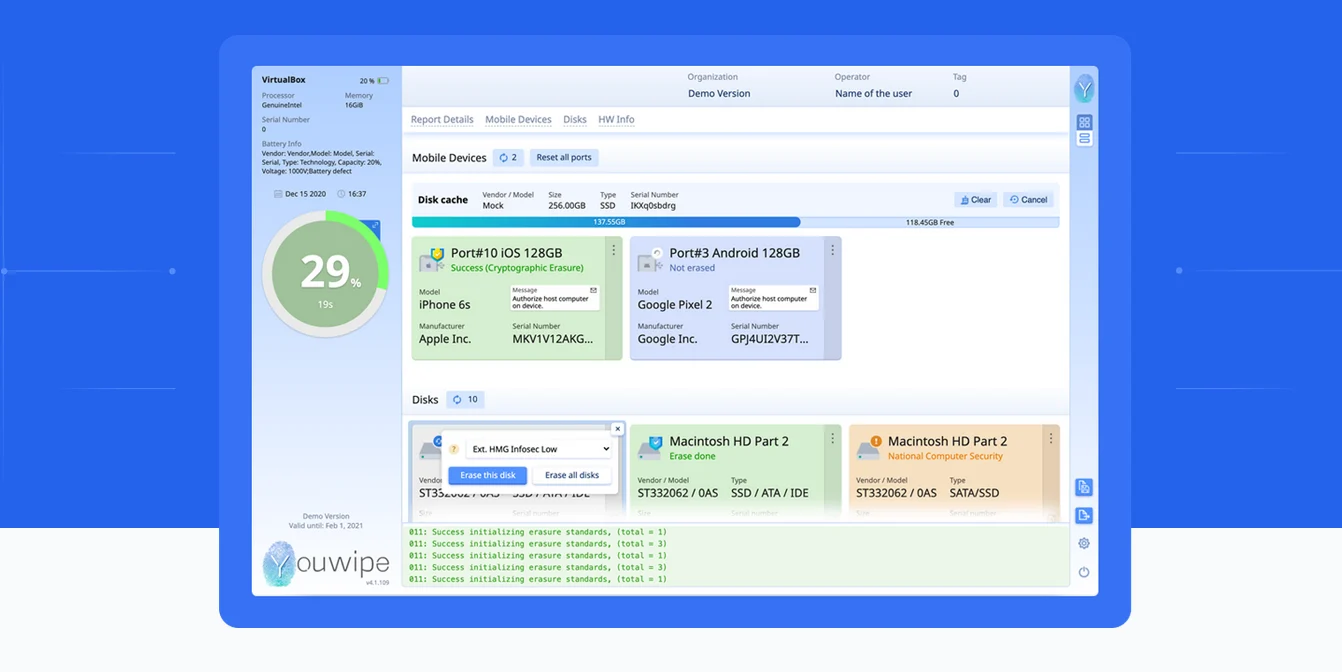
Software erasure
Best for equipment you want to reuse
YouWipe overwrites the data so equipment can be reused or resold, and each erased device is documented. Erasure certificates are available for each device.
EXTECH collects your retired IT equipment, records it, erases or shreds the data, and gives you the paperwork to prove it. Auckland site in Onehunga, collections across the region.
We collect retired IT equipment from Auckland organisations, log every asset, then erase the data for reuse or shred the media. You get records showing exactly where your equipment and data went.
One provider covers the whole job, from a single laptop refresh to a full server room clear-out. See our IT asset disposal, electronics recycling and IT infrastructure decommissioning services for the full scope.
Laptops, servers, phones and copiers keep personal information long after they stop being useful. Under the Privacy Act 2020, in force since 1 December 2020, the organisation that holds that information stays responsible for protecting it, including when the hardware leaves the building.
Auckland has about a third of New Zealand’s population and produces roughly 38% of national GDP (Auckland Economic Monitor), so a large share of the country’s corporate hardware refreshes happen here. Events like Windows 10 reaching end of support on 14 October 2025 push whole fleets into retirement at once. We cover that in The Windows 10 ghost fleet, and in why secure e-waste disposal is now a critical cybersecurity requirement.
General information only, not legal advice. Last reviewed October 2026. Source: Community Law and the Office of the Privacy Commissioner. Check current requirements with your legal adviser.
EXTECH collects from business, government and institutional sites across the Auckland region, from CBD towers to East Tāmaki warehouses. Choose a zone to see the suburbs it covers.
Albany, Rosedale, Takapuna, Wairau Valley, Glenfield, Birkenhead, Browns Bay, Orewa, Silverdale
CBD, Wynyard Quarter, Newmarket, Parnell, Mt Eden, Greenlane, Ellerslie, Penrose, Mt Wellington
Henderson, Westgate, Massey, Avondale, New Lynn, Glen Eden, Te Atatu, Kumeu
East Tamaki, Highbrook, Pakuranga, Botany, Howick, Panmure, Otara
Manukau, Wiri, Manurewa, Papatoetoe, Mangere, Otahuhu, Favona, Auckland Airport area
Papakura, Takanini, Drury, Pukekohe, Waiuku
In a CBD tower or other multi-tenant building? Tell us about lift bookings, loading docks and building rules when you book. Outlying area or not listed? Ask us and we will arrange logistics.
Retired equipment is rarely just the laptops on the asset register. These are the places data risk shows up most often, by sector.
Client files and privileged material sit on laptops, file servers and scanners. Retention rules often decide when equipment can be retired.
Customer financial records live on laptops, branch devices and back-office servers, and auditors expect evidence of how they were destroyed.
Patient and client information sits on shared workstations, clinical PCs and imaging equipment. Health agencies also work under the Health Information Privacy Code 2020.
Staff and student records are spread across staff laptops, lab PCs, storage rooms and old servers that no one wants to switch off.
Public records and citizen data are common, and procurement teams often ask for documented chain of custody for disposal.
Point-of-sale terminals, handhelds, networking gear and warehouse PCs all carry configuration data and sometimes customer details.
Client fleets are refreshed in batches. Each client’s equipment needs its own records so you can prove what belonged to whom.
Multifunction printers and copiers can contain hard drives that keep copies of scanned and printed documents. They are easy to forget.
Every job follows the same six steps, built around records you can keep and show to an auditor.
Request a quote or book a collection online, or call 0800 4 EXTECH. Send an asset list, or rough quantities if you do not have one yet.
We collect from your site. A manifest with time-stamped photos records what left your premises.
Equipment travels under tracked logistics, with custody recorded from your door to our facility.
Assets are audited and logged on arrival, which gives you a clear record of what we received.
Working equipment is erased with YouWipe software so it can be reused. Media that has failed, or must be destroyed, is shredded to 20mm fragments.
You receive your records, and certificates of destruction are available. Reusable equipment is assessed for resale, and the rest is dismantled and recycled responsibly.
Deleting files does not remove data. We use two methods and match each one to the risk. Our data destruction and data security pages go deeper.
Best for equipment you want to reuse
YouWipe overwrites the data so equipment can be reused or resold, and each erased device is documented. Erasure certificates are available for each device.
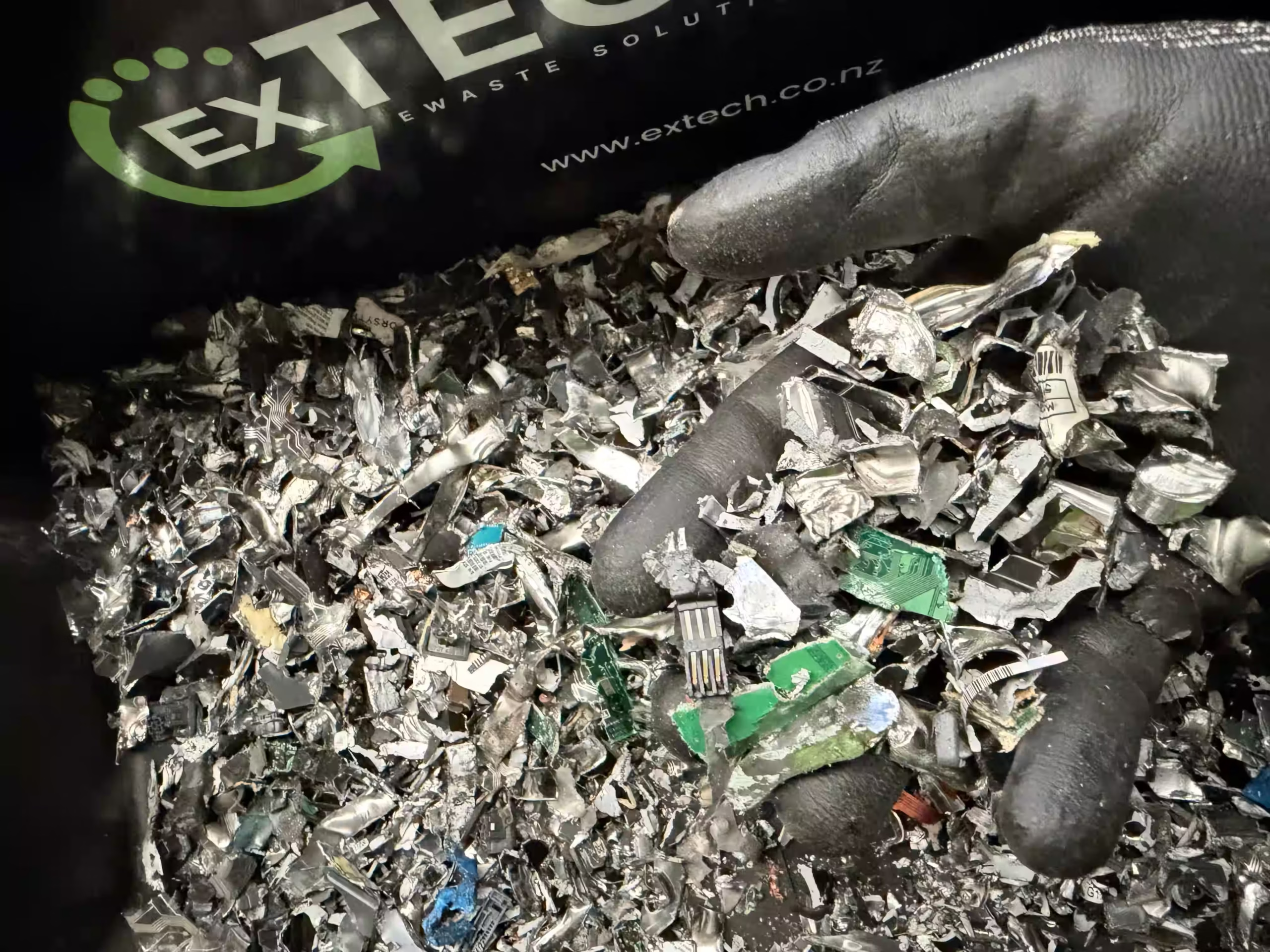
Best for failed or high-risk media
Industrial cross-cut shredding reduces hard drives, SSDs and smartphones to 20mm fragments. It suits media that has failed, cannot be reliably erased, or must be physically destroyed. Serialised certificates of destruction are available.
EXTECH is a YouWipe partner. The NATO and Common Criteria EAL+3 certifications apply to the YouWipe software, and you can check it in NATO’s product catalogue.
A practical list for the person organising the clear-out. Work through it before you book and again before pickup day.
Want us to look at your plan? Send us the details.
Straight answers on collection, data destruction and the Privacy Act. Not covered here? Ask us.
Yes. EXTECH has an Auckland site in Onehunga and collects from business, government and institutional sites across the Auckland region. Outside Auckland and Wellington, we arrange logistics when you submit a collection request. Book online or call 0800 4 EXTECH with your suburb, rough quantities and access details.
You receive records rather than a promise. Collections are recorded with a manifest and time-stamped photos, assets are audited and logged, erasure certificates are available for each erased device, and serialised certificates of destruction are available for shredded media. Erasure uses YouWipe, software that holds NATO and Common Criteria EAL+3 certification, which you can check in NATO’s product catalogue.
It depends on the risk. Software erasure suits working equipment you want to reuse or resell, because the device stays usable. Industrial shredding suits media that has failed, cannot be reliably erased, or must be physically destroyed. EXTECH shreds hard drives, SSDs and smartphones to 20mm fragments.
Information privacy principle 5 requires reasonable security safeguards against loss, misuse and unauthorised access to personal information, and principle 9 says not to keep personal information longer than necessary. Retired devices still hold personal information until it is properly erased or destroyed. If a privacy breach causes or is likely to cause serious harm, you must notify the Privacy Commissioner and affected people. This is general information, not legal advice.
Working equipment is erased with YouWipe and assessed for resale, because reuse comes before recycling. Anything that cannot be reused is dismantled and recycled responsibly. Ask us whether reuse is realistic for your fleet.
An asset list if you have one, or rough quantities by type. Where the equipment is stored, which floor, and how vehicles get access (lifts, loading dock, parking). Any building rules such as lift bookings or site induction. And anything needing special handling, such as batteries, UPS units or racked servers.
It depends on what you are sending, how much, where it is, and whether any of it has reuse value. Send an asset list or rough quantities through the enquiry form and we will come back with a quote.
Yes. EXTECH also has a site in the Hutt Valley, Wellington, and arranges collection across New Zealand.
Send an asset list or rough quantities and tell us your suburb. We will come back with a quote and a collection plan.